01
Genetic continuity is based on DNA information storage and transmission
Genes, chromosomes and genomes are three different levels of the same information.
- Gene — a segment of DNA whose sequence specifies a functional product (RNA or protein), together with the signals that control its expression
- Chromosome — the DNA molecule packaged with proteins; prokaryotes usually carry one circular chromosome, eukaryotes several linear ones
- Genome — the complete DNA content of a cell or organism, including coding and non-coding regions
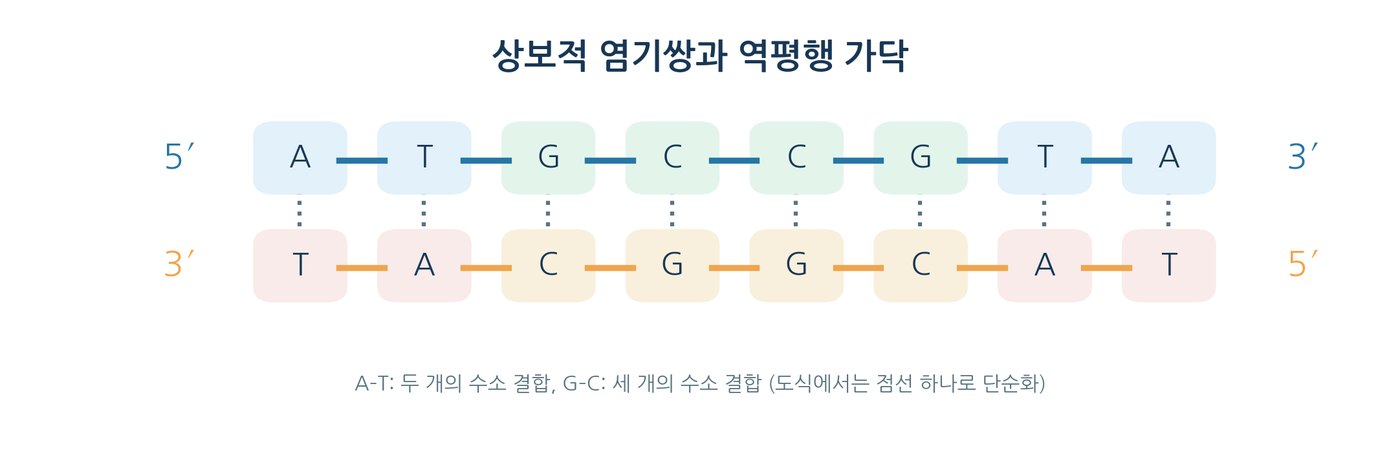
- Base pairing — A–T and G–C pairs hold two antiparallel strands together, so one strand templates the other
- Antiparallel — one strand runs 5′→3′ while its partner runs 3′→5′
- Implication — the sequence is copied with high fidelity and can be repaired, which is what makes heredity stable
02
DNA is replicated with high accuracy and continuously repaired
Complementary base pairing alone is not accurate enough; proofreading and repair add several orders of magnitude.
- Semiconservative replication — each daughter molecule keeps one parental strand and one new strand
- Meselson–Stahl — one intermediate band in the first generation, intermediate plus light bands in the second, distinguishes semiconservative from conservative copying
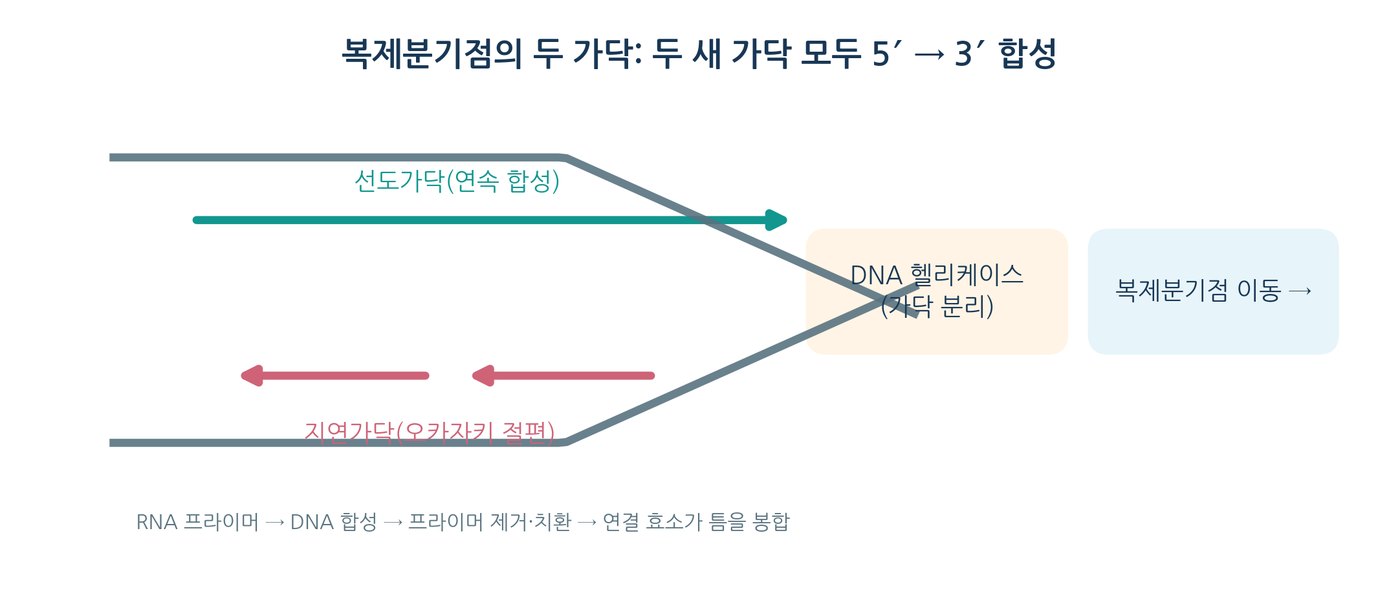
- Direction — DNA polymerase adds dNTPs to the 3′-OH end, so the new strand grows 5′→3′ while the template is read 3′→5′
- Leading and lagging strands — continuous synthesis on one side, Okazaki fragments on the other
- Machinery — helicase unwinds, primase lays RNA primers, polymerase extends, ligase seals nicks
- Proofreading — the 3′→5′ exonuclease activity of many replicative polymerases removes misincorporated bases
- Mismatch repair — corrects errors that survive replication
- Error rate — textbooks quote roughly one error per 10⁹–10¹⁰ bases after proofreading and repair; observed mutation rates vary with organism and conditions
- Damage ≠ replication error — damage is chemical alteration of DNA; a replication error is a wrong base in the new strand. Unrepaired damage can become a permanent mutation
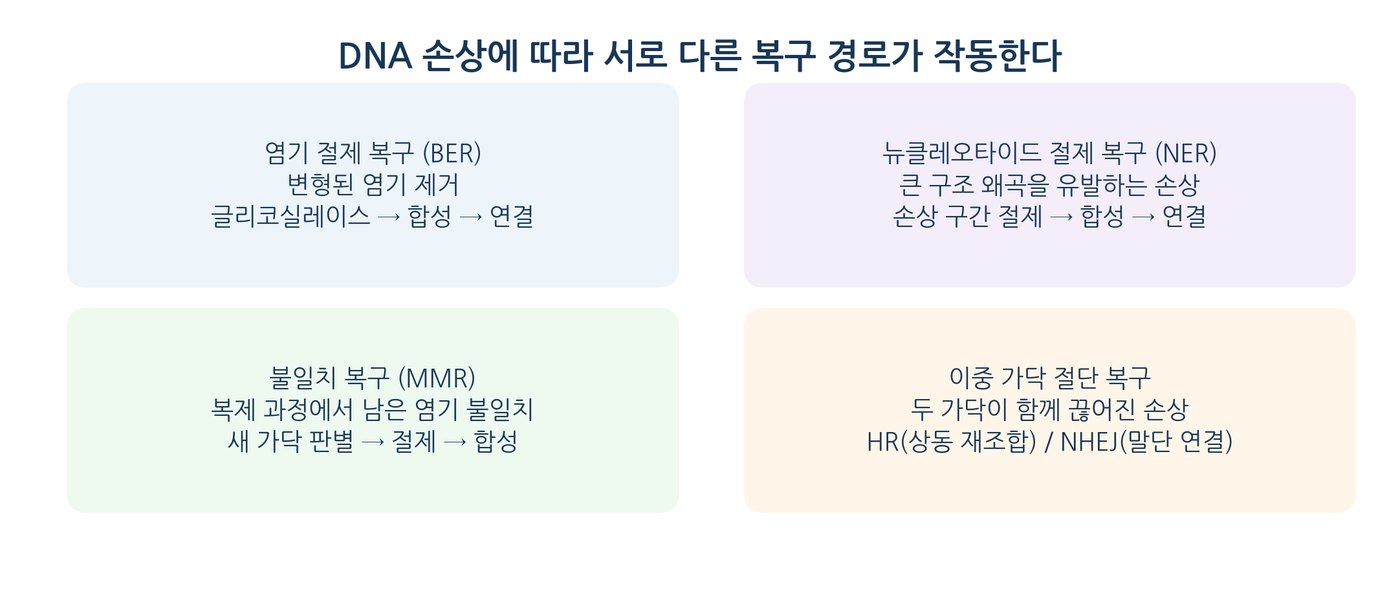
- Repair routes — base excision repair, nucleotide excision repair (UV photoproducts), mismatch repair, homologous recombination and non-homologous end joining for double-strand breaks
- Expected errors — E = Np; for N = 4.0 × 10⁶ and p = 1.0 × 10⁻⁹, E = 4.0 × 10⁻³ and P(≥1) ≈ 0.40 %
New strand: 5′ → 3′ · template read: 3′ → 5′
E = Np · P(≥1) ≈ 1 − e−Np
NOTERepair is not always perfect restoration. Depending on the pathway chosen, repair can leave small insertions, deletions or rearrangements.
03
Linear DNA sequence leads to three-dimensional protein structure and function
DNA → RNA → protein is the main flow, but it is not the only flow and not a complete description of function.
- Transcription — RNA polymerase reads the template strand 3′→5′ and synthesises RNA 5′→3′; RNA uses ribose and uracil
- Example — coding 5′-ATG GAA TTT TGA-3′ → mRNA 5′-AUG GAA UUU UGA-3′
- Processing — eukaryotic pre-mRNA acquires a 5′ cap, spliced exons and a poly(A) tail; alternative splicing yields different products from one gene
- Genetic code — 4³ = 64 codons; 61 specify amino acids, UAA/UAG/UGA terminate, AUG starts and codes methionine
- Translation — tRNA anticodons read codons; aminoacyl-tRNA synthetases charge tRNAs; the ribosome catalyses peptide bond formation in its rRNA
- Example — AUG GAA UUU UGA gives Met–Glu–Phe; the stop codon is a signal, not a residue
- Structure levels — primary sequence, secondary α-helix/β-sheet, tertiary folding of one chain, quaternary assembly of several chains
- Sequence is necessary, not sufficient — pH, ionic strength, temperature, redox state, ligands and chaperones all shape the actual structure
- Mutation outcomes — synonymous, missense, nonsense and frameshift changes; sickle-cell β-globin Glu→Val shows one substitution altering molecular behaviour
- Expression matters — cells with near-identical genomes differ in which genes they express, at which level, and in what quantity
References
| Term | Core meaning | Example and distinction |
|---|---|---|
| Nucleotide | Basic unit of base, sugar and phosphate | The A, T, G and C nucleotides of DNA |
| Gene | DNA segment associated with a functional product | Protein-coding gene; rRNA gene |
| Chromosome | Organised unit of DNA transmission | One human chromosome before replication: one continuous DNA molecule |
| Genome | The complete set of genetic information | Includes relevant organellar DNA as well as nuclear DNA |
| Plasmid | Independently replicating DNA element distinct from the chromosome | Carries antibiotic-resistance genes in some bacteria |
| After transfer to ¹⁴N medium | Heavy DNA (HH) | Hybrid DNA (HL) | Light DNA (LL) |
|---|---|---|---|
| Generation 0 | 100% | 0% | 0% |
| Generation 1 | 0% | 100% | 0% |
| Generation 2 | 0% | 50% | 50% |
| Generation 3 | 0% | 25% | 75% |
| Component | Main role | Biochemical point |
|---|---|---|
| DNA helicase | Separates the two strands | Opens the duplex at the replication fork |
| Topoisomerase | Relieves torsional stress | Manages supercoiling ahead of the fork |
| Single-strand DNA-binding protein | Protects exposed single strands | Prevents reannealing, degradation and aberrant structure |
| Primase | Synthesises a short primer | Provides the 3′-OH end that polymerase requires |
| DNA polymerase | Synthesises the new strand and proofreads | Adds dNTPs complementary to the template, 5′→3′ |
| Primer removal and replacement factors | Process the RNA primer | Replace the primer segment with DNA |
| DNA ligase | Seals nicks between fragments | Forms the phosphodiester bond |
| Cause or situation | Change at the DNA level | Typical response |
|---|---|---|
| Ultraviolet light | Abnormal covalent bonds between adjacent pyrimidines | Nucleotide excision repair |
| Spontaneous deamination | Chemical conversion of cytosine and others | Base excision repair |
| Oxidative stress | Oxidised bases and strand damage | Base excision repair and others |
| DNA synthesis error | Mismatched base pair with the template | Proofreading and mismatch repair |
| Double-strand break | Both strands cut | Homologous recombination or non-homologous end joining |
| Level | Core concept | Main elements involved |
|---|---|---|
| Primary | Covalent arrangement of amino acids | Peptide bonds and sequence |
| Secondary | Local regular structure of the backbone | Hydrogen bonds, α-helix, β-sheet |
| Tertiary | Overall folding of one chain | Hydrophobic effect, hydrogen bonds, ionic interactions, disulfide bonds |
| Quaternary | Assembly of several polypeptides | Noncovalent or some covalent bonds between subunits |
| Observation or prediction | Generation 1 | Generation 2 | Generation 3 |
|---|---|---|---|
| HL fraction, semiconservative model | 100% | 50% | 25% |
| LL fraction, semiconservative model | 0% | 50% | 75% |
| Feature to compare with the data | One intermediate band | Intermediate plus light band | Rising light-band fraction |
| Mean error probability p | Expected errors per million bases | Expected errors for N = 2 × 10⁶ |
|---|---|---|
| 10⁻⁵ | 10 | 20 |
| 10⁻⁷ | 0.1 | 0.2 |
| 10⁻⁹ | 0.001 | 0.002 |
| Sequence type | mRNA (5′→3′) | Translation product |
|---|---|---|
| Reference | AUG GAA UUU UGA | Met–Glu–Phe–Stop |
| Substitution | AUG GAC UUU UGA | Met–Asp–Phe–Stop |
| Single-base deletion | AUG AAU UUU GA… | Met–Asn–Phe–… |
| Term | Summary |
|---|---|
| Antiparallel and complementary | The two DNA strands run in opposite directions, and A–T and G–C pairing allows template copying |
| Semiconservative replication | Each daughter DNA molecule has one parental strand and one new strand |
| Replication accuracy | Base selection, proofreading and mismatch repair greatly reduce errors |
| DNA damage repair | BER, NER, HR and NHEJ act according to the type of damage |
| Transcription | RNA is synthesised 5′→3′ on the DNA template |
| Translation | The ribosome decodes mRNA codons to synthesise a polypeptide |
| Protein folding | Sequence and environment together determine three-dimensional structure and dynamic function |
| First two bases | Third base U | Third base C | Third base A | Third base G |
|---|---|---|---|---|
| UU | UUU·Phe | UUC·Phe | UUA·Leu | UUG·Leu |
| UC | UCU·Ser | UCC·Ser | UCA·Ser | UCG·Ser |
| UA | UAU·Tyr | UAC·Tyr | UAA·Stop | UAG·Stop |
| UG | UGU·Cys | UGC·Cys | UGA·Stop | UGG·Trp |
| CU | CUU·Leu | CUC·Leu | CUA·Leu | CUG·Leu |
| CC | CCU·Pro | CCC·Pro | CCA·Pro | CCG·Pro |
| CA | CAU·His | CAC·His | CAA·Gln | CAG·Gln |
| CG | CGU·Arg | CGC·Arg | CGA·Arg | CGG·Arg |
| AU | AUU·Ile | AUC·Ile | AUA·Ile | AUG·Met |
| AC | ACU·Thr | ACC·Thr | ACA·Thr | ACG·Thr |
| AA | AAU·Asn | AAC·Asn | AAA·Lys | AAG·Lys |
| AG | AGU·Ser | AGC·Ser | AGA·Arg | AGG·Arg |
| GU | GUU·Val | GUC·Val | GUA·Val | GUG·Val |
| GC | GCU·Ala | GCC·Ala | GCA·Ala | GCG·Ala |
| GA | GAU·Asp | GAC·Asp | GAA·Glu | GAG·Glu |
| GG | GGU·Gly | GGC·Gly | GGA·Gly | GGG·Gly |