Living organisms exist in a dynamic steady state, not at equilibrium
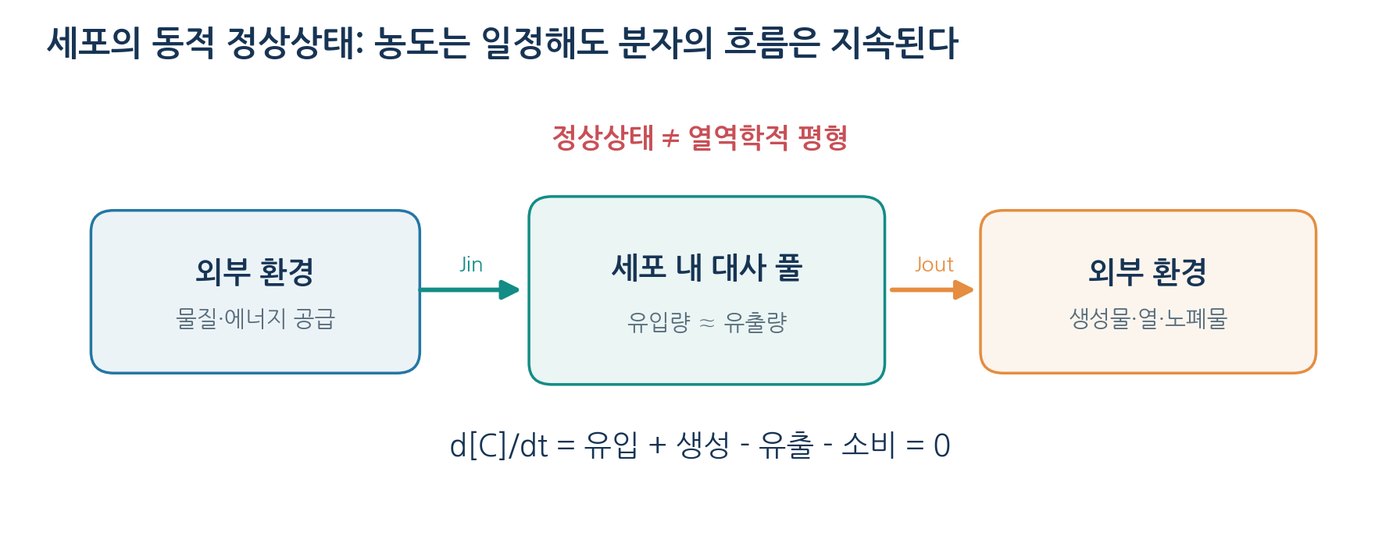
A cell exchanges both matter and energy with its surroundings; constancy of concentration is maintained by continuous flow.
- Open system — the cell exchanges matter and energy with its surroundings; the membrane is a selective boundary, not an absolute wall
- Energy input — harvested from carbohydrates and lipids or from light; partly spent on ATP synthesis, transport, motility and biosynthesis
- Output — heat and waste matter are released back to the surroundings
- Steady state ≠ equilibrium — in a steady state concentrations barely change while reactions and transport continue; at equilibrium the net driving force ΔG is zero
- Material balance — d[C]/dt = Jin − Jout + vproduction − vconsumption
- Key point — d[C]/dt = 0 does not mean each flux or rate is zero
- Worked example — ATP production 8 and consumption 8 mmol·L⁻¹·min⁻¹ gives d[ATP]/dt = 0; if consumption rises to 11, the pool falls at 3 mmol·L⁻¹·min⁻¹ until regulation raises production
Organisms transform energy and matter obtained from the surroundings
Catabolism releases energy and reducing power; anabolism spends them to build cell components.
- Metabolism — the network of enzyme-catalysed reactions inside the cell
- Catabolism — breaks nutrients into smaller molecules, passes electrons to reduced carriers, and yields energy for ATP synthesis
- Anabolism (biosynthesis) — builds amino acids, nucleotides and lipids into cell components, usually consuming ATP and NADPH
- First law — energy is neither created nor destroyed, only converted: ΔU = q + w for a closed system
- Three kinds of work — chemical (synthesis of protein and DNA), transport (ions moved against a gradient), mechanical (muscle contraction, motor proteins)
- Caveat — living systems are open, so the real energy balance includes energy carried by matter crossing the boundary
Organisms transform energy and matter obtained from the surroundings
Catabolism releases energy and reducing power; anabolism spends them to build cell components.
- Metabolism — the network of enzyme-catalysed reactions inside the cell
- Catabolism — breaks nutrients into smaller molecules, passes electrons to reduced carriers, and yields energy for ATP synthesis
- Anabolism (biosynthesis) — builds amino acids, nucleotides and lipids into cell components, usually consuming ATP and NADPH
- First law — energy is neither created nor destroyed, only converted: ΔU = q + w for a closed system
- Three kinds of work — chemical (synthesis of protein and DNA), transport (ions moved against a gradient), mechanical (muscle contraction, motor proteins)
- Caveat — living systems are open, so the real energy balance includes energy carried by matter crossing the boundary
Electron flow provides energy for life
Oxidation and reduction are the currency; carriers split a large free-energy drop into manageable steps.
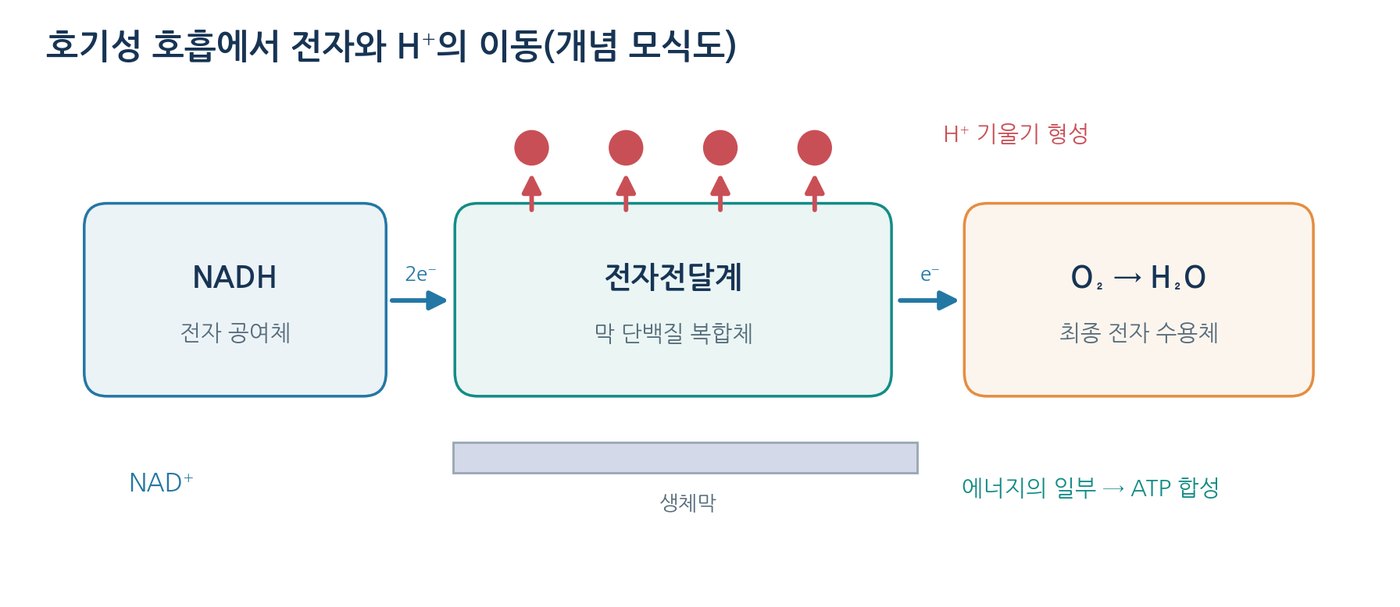
- Oxidation — loss of electrons; reduction — gain of electrons. The donor is oxidised, the acceptor reduced
- Carriers — NAD⁺/NADH, FAD/FADH₂, quinones, iron–sulfur proteins, cytochromes; electrons rarely travel free
- Electron transport chain — electrons pass through inner-membrane complexes to oxygen, forming water; some complexes pump H⁺ across the membrane
- Proton-motive force — the H⁺ concentration difference plus membrane potential drives ATP synthase
- Reduction potential — electrons flow favourably from a more negative to a more positive E°′
- Worked example — NAD⁺/NADH E°′ ≈ −0.32 V and O₂/H₂O E°′ ≈ +0.82 V give ΔE°′ = +1.14 V, so ΔG°′ = −2 × 96.485 × 1.14 ≈ −220 kJ/mol per NADH
- Caution — this is a theoretical standard value; the cell does not convert all of it into ATP
[Separate note 1-3] Entropy: the advantage of disorder
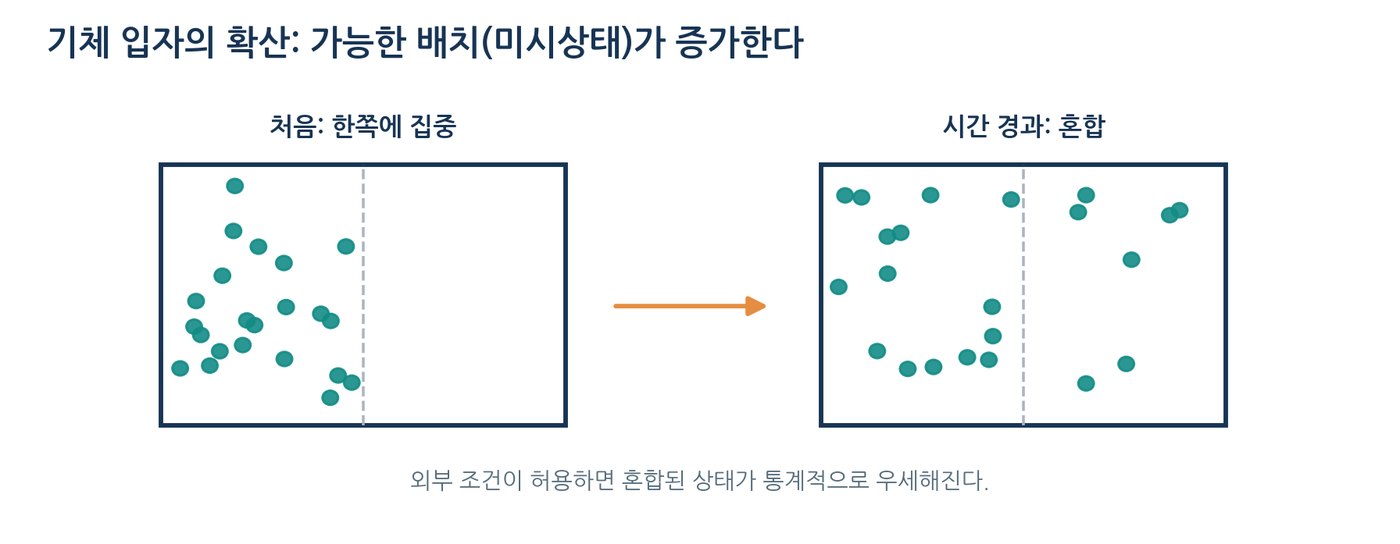
Entropy counts the microscopic arrangements consistent with a macroscopic state — not simply "tidiness".
- Boltzmann relation — S = kB ln Ω links entropy to the number of microstates
- What changes entropy — heat flow, mixing, concentration change, and changes in molecular degrees of freedom
- Second law — ΔStotal = ΔSsystem + ΔSsurroundings ≥ 0 for a spontaneous process in an isolated whole
- Why cells do not violate it — a cell maintains internal order by consuming nutrients and releasing heat and waste, which raises the entropy of the surroundings
- Common error — concluding "order increased, therefore impossible". Spontaneity is judged by ΔStotal, or by ΔG at constant temperature and pressure
- Thought experiment — separating a mixed solution generally requires work; selective membrane transport is how the cell sustains such gradients
Creating and maintaining order requires work and energy
ΔG combines enthalpy and entropy into a single criterion for direction at constant temperature and pressure.
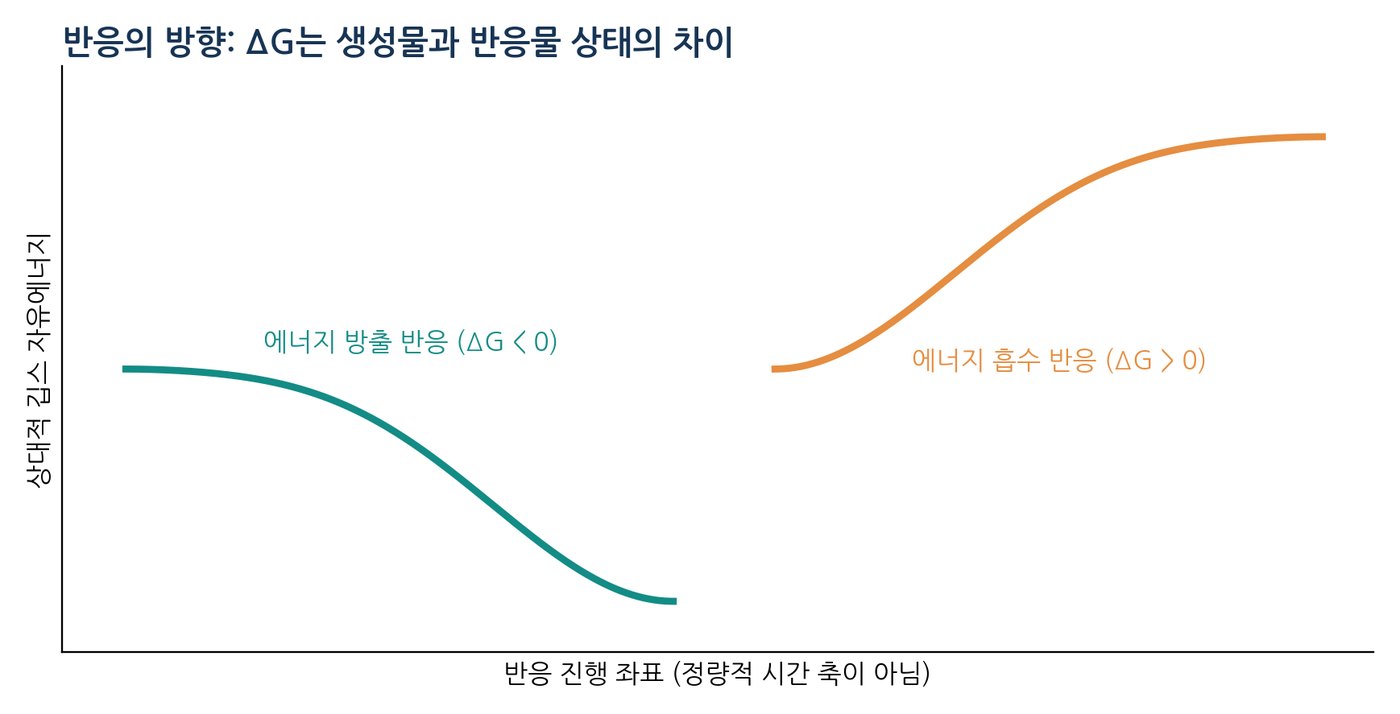
- Definition — G = H − TS, so at constant T, ΔG = ΔH − TΔS
- Reading the sign — ΔG < 0 favours the forward reaction, ΔG > 0 favours the reverse, ΔG = 0 means equilibrium
- Exothermic ≠ spontaneous — a reaction with ΔH < 0 can be non-spontaneous if the entropy term is unfavourable
- Worked example — ΔH = +20 kJ/mol with ΔS = +0.10 kJ·mol⁻¹·K⁻¹ gives ΔG = 20 − 29.8 ≈ −9.8 kJ/mol at 298 K: endothermic yet favourable
- Temperature dependence — the −TΔS term grows with T, so the direction can change with temperature
Creating and maintaining order requires work and energy
ΔG combines enthalpy and entropy into a single criterion for direction at constant temperature and pressure.
- Definition — G = H − TS, so at constant T, ΔG = ΔH − TΔS
- Reading the sign — ΔG < 0 favours the forward reaction, ΔG > 0 favours the reverse, ΔG = 0 means equilibrium
- Exothermic ≠ spontaneous — a reaction with ΔH < 0 can be non-spontaneous if the entropy term is unfavourable
- Worked example — ΔH = +20 kJ/mol with ΔS = +0.10 kJ·mol⁻¹·K⁻¹ gives ΔG = 20 − 29.8 ≈ −9.8 kJ/mol at 298 K: endothermic yet favourable
- Temperature dependence — the −TΔS term grows with T, so the direction can change with temperature
Energy coupling links biological reactions
An unfavourable reaction proceeds only when it shares a reaction pathway with a favourable one.
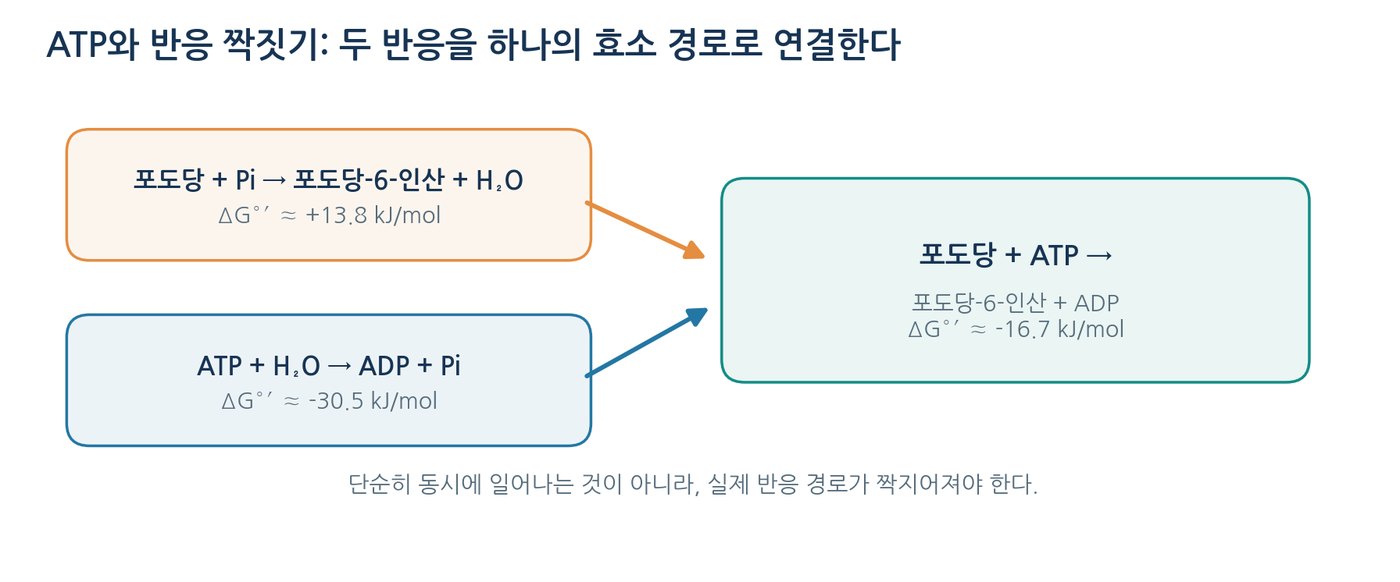
- Coupling — a common intermediate or a shared structural change connects the two reactions
- Additivity — for reactions that form one pathway, ΔGoverall = ΔG₁ + ΔG₂
- Not additivity by proximity — two reactions merely occurring in the same tube do not drive each other
- Glucose phosphorylation — hexokinase transfers the γ-phosphate of ATP to glucose, making the overall path favourable
- ATP hydrolysis — ΔG°′ ≈ −30.5 kJ/mol is commonly quoted at about 25 °C; the real value depends on pH, Mg²⁺ and ionic strength
- Misconception — "breaking a bond releases energy" is inaccurate: the net free-energy change comes from resonance stabilisation, hydration, ionisation and entropy of the products
- Other currencies — the H⁺ electrochemical gradient, NADPH reducing power, and Na⁺ or H⁺ symport/antiport
K′eq and ΔG°′ measure the tendency of a reaction to proceed
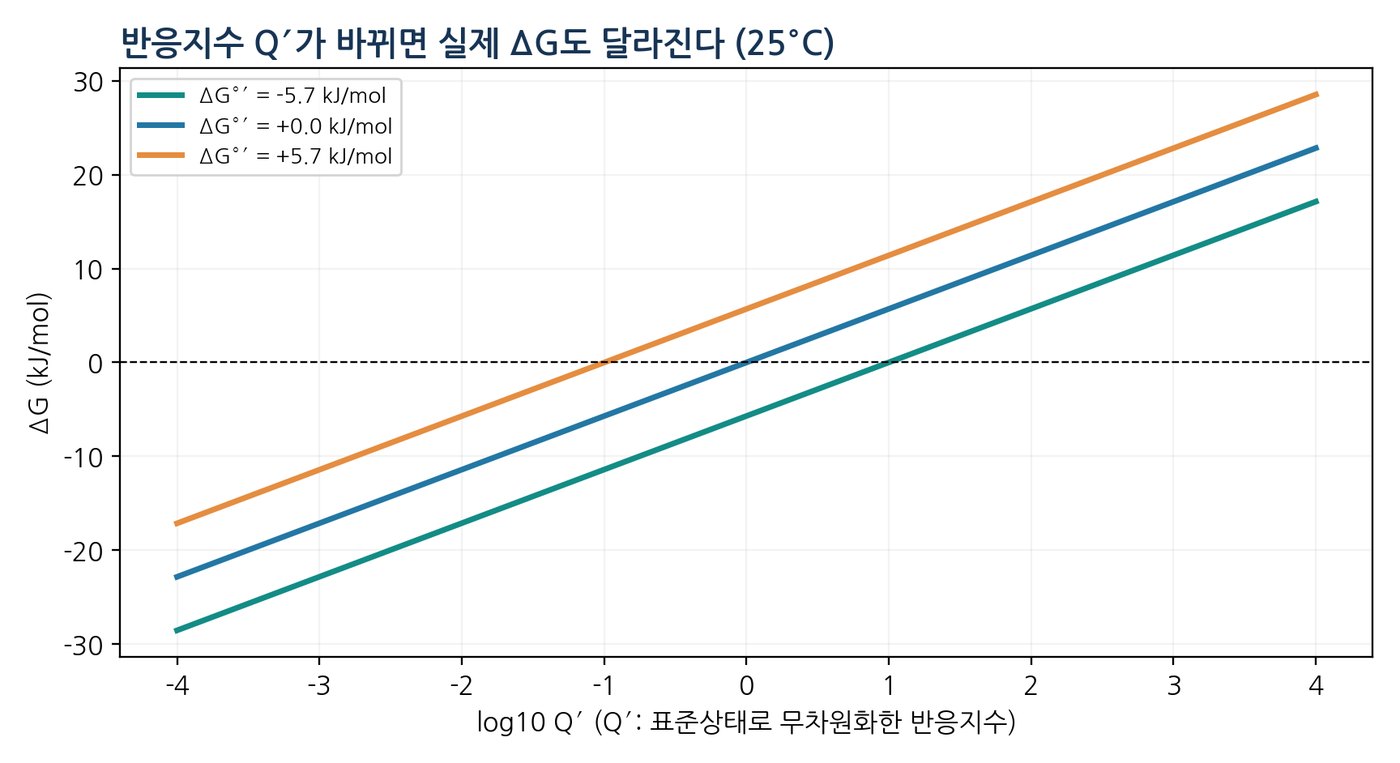
Standard conditions give ΔG°′; actual conditions give ΔG. Only ΔG answers "which way, now".
- Biochemical standard state — pH fixed at 7, so H⁺ activity is held constant; other solutes use their own reference states
- Reaction quotient Q′ — dimensionless combination of product and reactant activities at the current composition
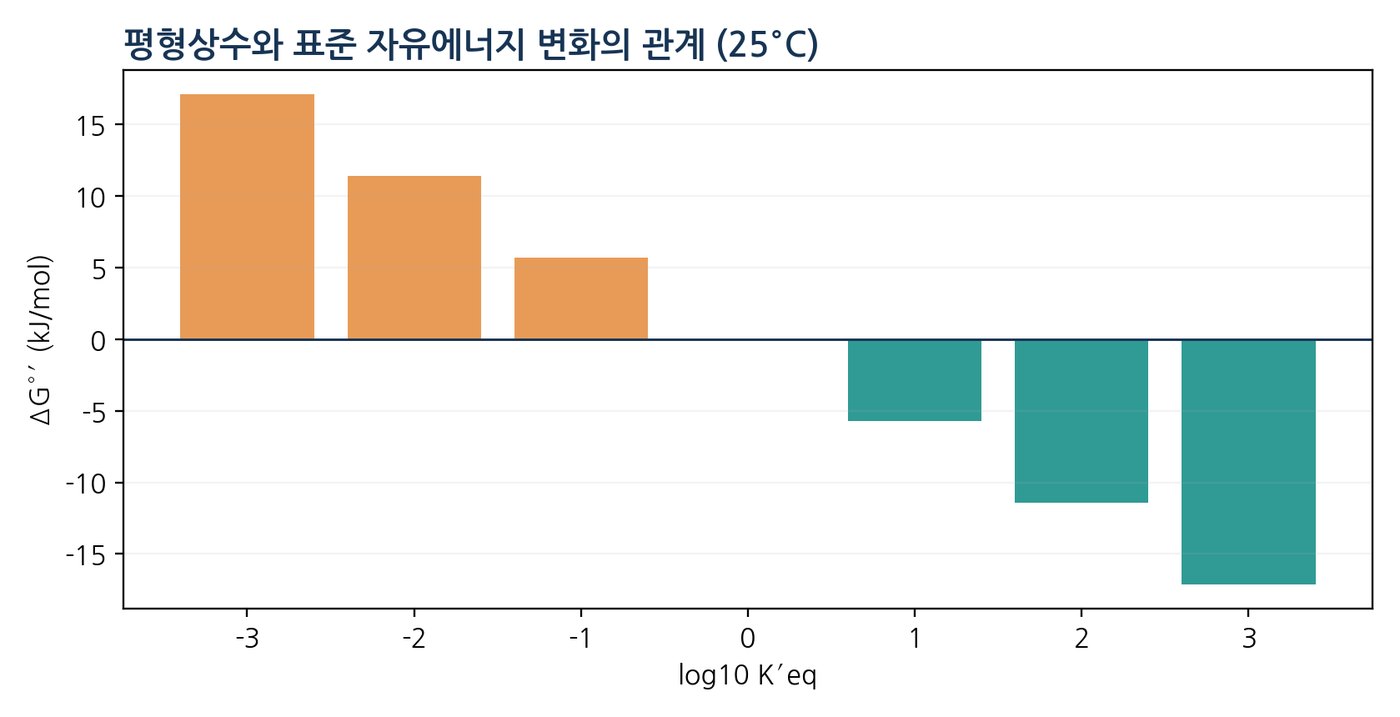
- Relation — ΔG = ΔG°′ + RT ln Q′; at equilibrium ΔG = 0 and Q′ = K′eq, so ΔG°′ = −RT ln K′eq
- Constants — R = 8.314 J·mol⁻¹·K⁻¹; at 25 °C, RT ≈ 2.479 kJ/mol and RT ln 10 ≈ 5.708 kJ/mol
- Direction — Q′ < K′eq gives ΔG < 0 (forward favoured); Q′ > K′eq favours the reverse
- Worked example — K′eq = 100 gives ΔG°′ = −2.479 × 4.605 ≈ −11.42 kJ/mol; ΔG°′ = +5.71 kJ/mol gives K′eq ≈ 0.100
- Worked example — ΔG°′ = +5.71 kJ/mol with Q′ = 0.010 gives ΔG = 5.71 − 11.42 ≈ −5.71 kJ/mol: an unfavourable standard reaction running forward because products are scarce
Enzymes promote a sequence of chemical reactions
Enzymes lower the activation barrier; they do not change ΔG or the equilibrium constant.
- Mechanism — stabilise the transition state or provide an alternative pathway, lowering ΔG‡
- Both directions — forward and reverse rates are accelerated equally, so K′eq is unchanged
- Active site — binds substrate and positions catalytic groups; uses electrostatics, hydrogen bonding, acid–base, covalent and metal-ion catalysis
- Induced fit — enzyme and substrate structures can change on binding; not every enzyme uses the same mechanism
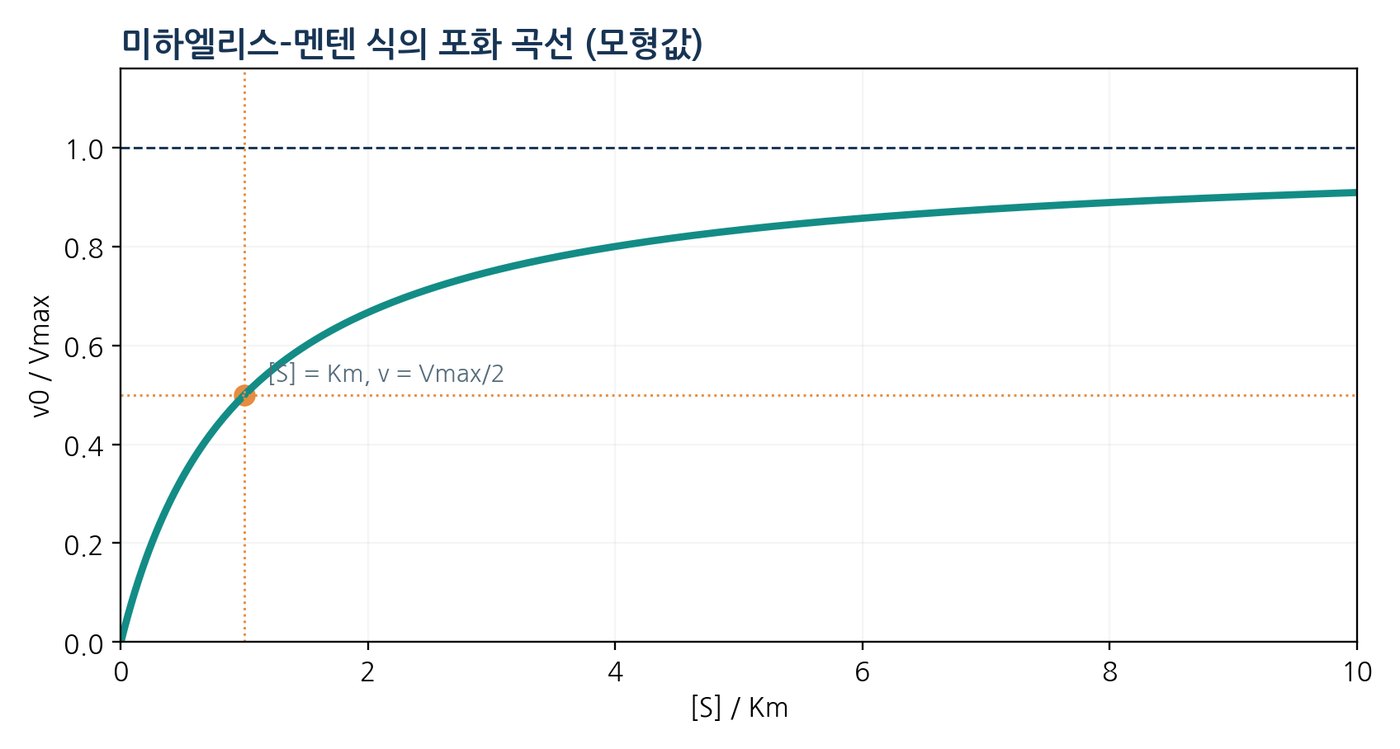
- Michaelis–Menten — v₀ = Vmax[S] / (Km + [S]) for initial rates with negligible reverse reaction
- Km — the substrate concentration giving v₀ = Vmax/2; only under special conditions does it approximate a dissociation constant
- Pathways and bottlenecks — flux through A → B → C depends on each enzyme, substrate supply and product removal; do not assume the first enzyme is always rate-limiting
Enzymes promote a sequence of chemical reactions
Enzymes lower the activation barrier; they do not change ΔG or the equilibrium constant.
- Mechanism — stabilise the transition state or provide an alternative pathway, lowering ΔG‡
- Both directions — forward and reverse rates are accelerated equally, so K′eq is unchanged
- Active site — binds substrate and positions catalytic groups; uses electrostatics, hydrogen bonding, acid–base, covalent and metal-ion catalysis
- Induced fit — enzyme and substrate structures can change on binding; not every enzyme uses the same mechanism
- Michaelis–Menten — v₀ = Vmax[S] / (Km + [S]) for initial rates with negligible reverse reaction
- Km — the substrate concentration giving v₀ = Vmax/2; only under special conditions does it approximate a dissociation constant
- Pathways and bottlenecks — flux through A → B → C depends on each enzyme, substrate supply and product removal; do not assume the first enzyme is always rate-limiting
Metabolism is regulated for balance and economy
Regulation changes flux through pathways, not the equilibrium of individual reactions.
- Why regulation — overproduction wastes precursors and ATP; underproduction limits growth and function
- Negative feedback — the end product inhibits an earlier enzyme, lowering further production
- Allosteric control — binding at a site other than the active site changes enzyme structure or kinetics
- Timescales — allosteric control acts in seconds, covalent modification in minutes, changes in enzyme amount in hours to days
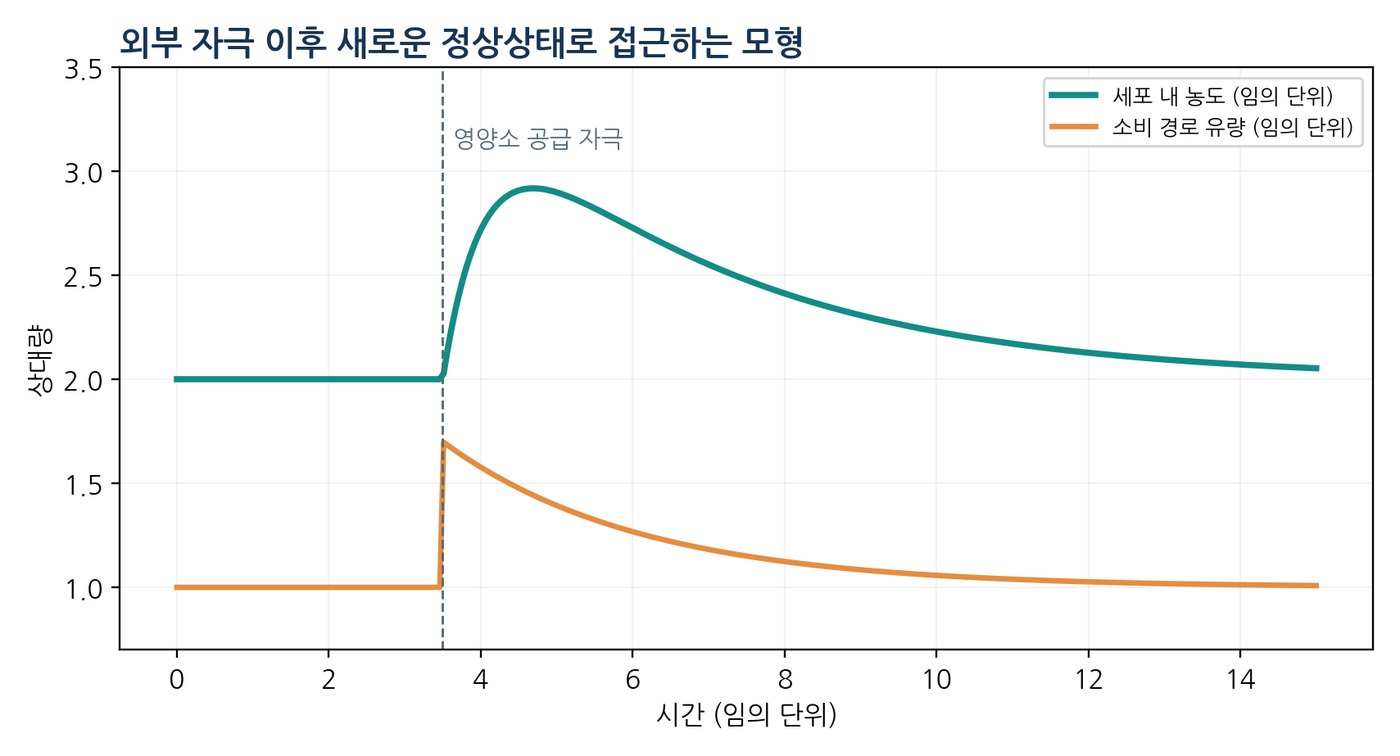
- Recovery — after a nutrient pulse, increased enzyme activity or use of alternative routes brings production and consumption back toward balance
- Signal ratios — ATP/ADP/AMP report energy status, NAD⁺/NADH reports redox tendency, NADPH/NADP⁺ supports reductive biosynthesis and antioxidant defence
- Reality — regulation is a network of integrated signals, not a single switch; delays and oscillations occur
Metabolism is regulated for balance and economy
Regulation changes flux through pathways, not the equilibrium of individual reactions.
- Why regulation — overproduction wastes precursors and ATP; underproduction limits growth and function
- Negative feedback — the end product inhibits an earlier enzyme, lowering further production
- Allosteric control — binding at a site other than the active site changes enzyme structure or kinetics
- Timescales — allosteric control acts in seconds, covalent modification in minutes, changes in enzyme amount in hours to days
- Recovery — after a nutrient pulse, increased enzyme activity or use of alternative routes brings production and consumption back toward balance
- Signal ratios — ATP/ADP/AMP report energy status, NAD⁺/NADH reports redox tendency, NADPH/NADP⁺ supports reductive biosynthesis and antioxidant defence
- Reality — regulation is a network of integrated signals, not a single switch; delays and oscillations occur
| System type | Exchange with surroundings | Examples |
|---|---|---|
| Open | Both matter and energy | Living cells, plant leaves |
| Closed | Energy but not matter | An idealised reaction vessel |
| Isolated | Neither matter nor energy | A perfectly isolated system is an idealisation |
| Basis | Catabolism | Anabolism |
|---|---|---|
| Main role | Breaks complex molecules to obtain precursors and energy | Joins small molecules to build cell components |
| Electron carriers | NAD⁺ → NADH and other reduced forms | NADPH → NADP⁺ and other reducing power consumed |
| Energy | Favourable reactions linked to ATP production | ATP input and reaction coupling |
| Examples | Glycolysis, fatty acid β-oxidation | Biosynthesis of protein, fatty acid and nucleic acid |
| Sign of ΔG | Direction at the current composition | Caution |
|---|---|---|
| ΔG < 0 | Forward reaction favoured | Does not mean the reaction is fast |
| ΔG = 0 | Equilibrium; no net driving force | Molecular motion and both directions continue |
| ΔG > 0 | Reverse reaction favoured | Coupling to another reaction can still drive the overall process |
| State | Comparison | Free energy | Favoured direction |
|---|---|---|---|
| More reactant than at equilibrium | Q′ < K′eq | ΔG < 0 | Forward |
| At equilibrium | Q′ = K′eq | ΔG = 0 | No net change |
| More product than at equilibrium | Q′ > K′eq | ΔG > 0 | Reverse |
| [S] / Km | v₀ / Vmax | Interpretation |
|---|---|---|
| 0.25 | 0.200 | Low substrate; a large effect from adding more |
| 0.50 | 0.333 | Sensitive to substrate increase |
| 1.00 | 0.500 | Km corresponds to half-maximal velocity |
| 2.00 | 0.667 | Approaching saturation |
| 4.00 | 0.800 | Diminishing additional effect |
| 10.00 | 0.909 | Close to Vmax |
| Mechanism | Approximate timescale | Main features |
|---|---|---|
| Change in substrate or product concentration | Seconds to minutes | Immediate change in Q′ and rate |
| Allosteric binding | Very fast | Reversible switching of enzyme activity |
| Covalent modification such as phosphorylation | Seconds to minutes | Changes in activity and interactions |
| Change in enzyme amount through transcription and translation | Minutes to hours or more | Longer-term change in metabolic capacity |
| Organelle and compartment structure | Persistent and dynamic | Access of reactants; separation and linking of pathways |
| Condition | Run 1 | Run 2 | Run 3 | Mean | Interpretation |
|---|---|---|---|---|---|
| A: baseline | |||||
| B: increased enzyme | |||||
| C: heat-treated |
| Q′ | ln Q′ | RT ln Q′ (kJ/mol) | ΔG (kJ/mol) | Forward direction |
|---|---|---|---|---|
| 0.001 | −6.908 | −17.12 | −11.41 | Favoured |
| 0.010 | −4.605 | −11.42 | −5.71 | Favoured |
| 0.100 | −2.303 | −5.71 | 0.00 | At equilibrium |
| 1.000 | 0.000 | 0.00 | +5.71 | Unfavourable |
| 10.000 | +2.303 | +5.71 | +11.42 | Unfavourable |